
Good customers of social media shield themselves by deleting suspicious “pal requests” which may function a gateway to dangerous content material. Equally, our immune system makes use of its personal judgment to establish mobile “profiles” that appear harmful. As immune cells patrol the physique, they try protein items referred to as antigens; generated when proteins are despatched to degradation, these items are introduced on the floor of cells. When an antigen sample seems suspicious, the immune system “hits delete” and eradicates the cell.
In most cancers, regulatory processes are disrupted, rising the probability that irregular proteins can be produced, and consequently, introduced as antigens on the mobile floor. But, regardless of their suspicious antigen profile, most cancers cells handle to evade the immune system’s watchful gaze.
A examine performed by Prof. Yifat Merbl’s crew within the Programs Immunology Division on the Weizmann Institute of Science has delved deep into the mobile supply of antigens—the waste-processing equipment generally known as the proteasome—and pulled out a beforehand unknown mechanism that permits most cancers cells to slide by immune system defenses. The findings had been not too long ago revealed in Nature Most cancers.
Most cancers: A distinct path to protein degradation
The proteasome’s job is to interrupt down worn-out or broken proteins into shorter protein chains referred to as peptides. Some peptides are then recycled, whereas others get processed into antigens, people who make up the mobile profile that’s introduced to the immune system.
This isn’t the primary time Merbl has turned the highlight on this mobile waste processing. Over the previous few years, her crew has developed applied sciences for monitoring down proteins that endure degradation by the proteasome. The ensuing knowledge is sufficiently detailed to disclose the distinctive construction of every degraded peptide.
Within the new examine, led by Aaron Javitt and Merav Shmueli, the crew utilized these applied sciences to create the first-ever map of proteasome degradation exercise in patient-derived tumor cells.
“We utilized our system to uncover what occurs in the middle of waste processing in tissues faraway from sufferers with a typical kind of lung most cancers,” Merbl says. “After we in contrast peptides derived from most cancers cells with these from adjoining, noncancerous tissue, we observed variations not solely within the subset of proteins that had been degraded, but in addition in the best way they’d been processed and minimize.”
This prompted the crew to look at the proteasome from a brand new perspective: Reasonably than trying on the peptides it generates, they targeted on the proteasome equipment itself. “We seemed on the cancerous tissue and questioned—what’s completely different in regards to the construction of its proteasomes?” Merbl asks.
A specialised ‘cookbook’ for most cancers survival
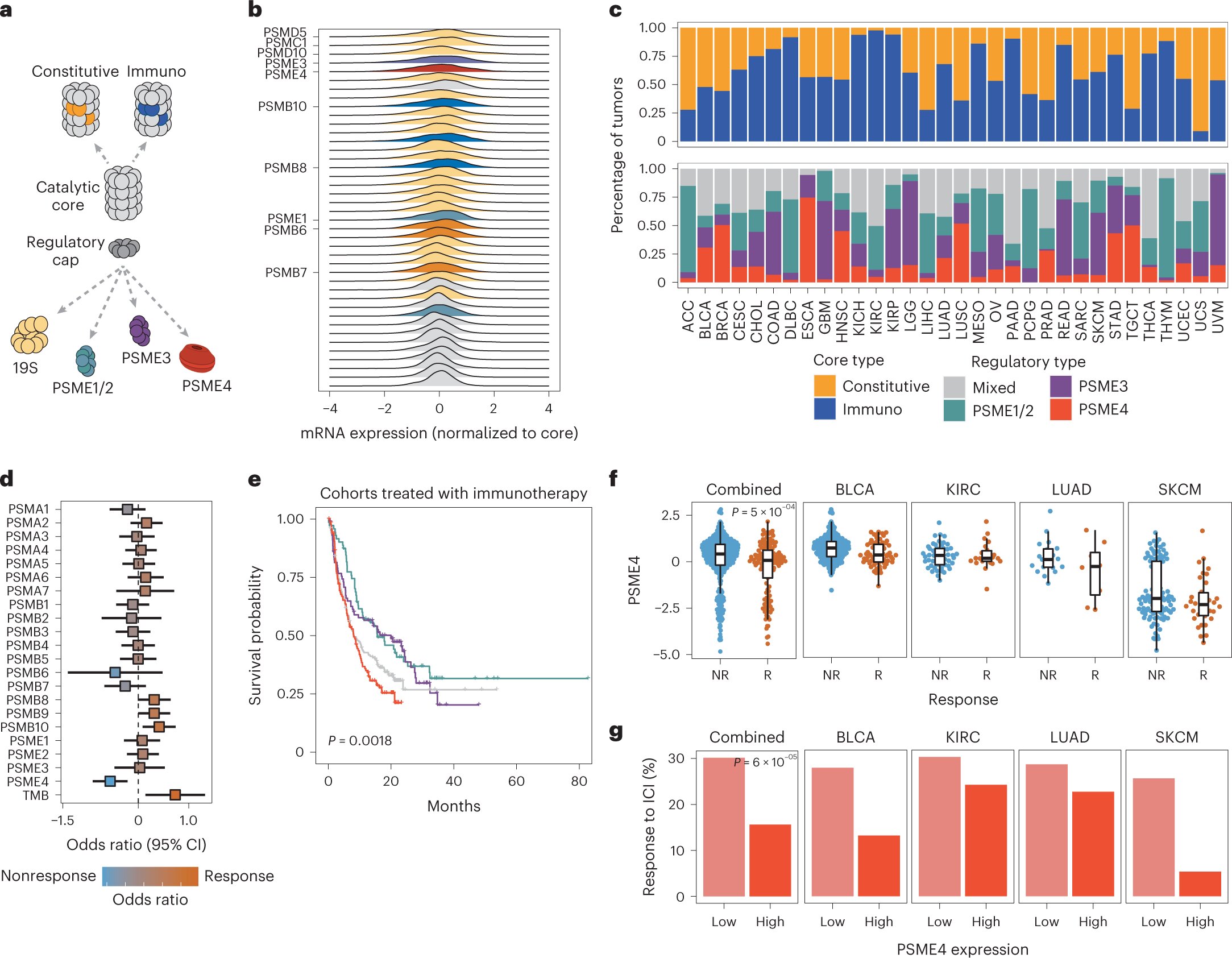
The proteasome is a protein advanced organized into an empty barrel-shaped tube made up of specialised protein-degrading enzymes. This core can work together with extra cap-like subunits that govern which proteins can entry the barrel for processing and the tempo at which they’re degraded. Several types of proteasomes are primarily categorised based mostly on the precise enzymes inside the barrel, and so they concentrate on various kinds of degradation. For instance, the immunoproteasome excels at producing peptides ideally suited to turning into antigens.
When the researchers began rummaging via the waste-processing equipment in tissues faraway from sufferers with lung most cancers, they famous an astonishingly massive variety of proteasomes that contained the protein PSME4. This protein, generally known as one of many regulatory “caps” making up the proteasome, was hardly ever present in proteasomes from adjoining, noncancerous tissues.
The crew then got down to characterize the distinctive degradation model of the PSME4-enriched proteasomes. As an instance what they discovered, think about completely different proteasomes as cooks with completely different seasoning preferences. Some would possibly want a bitter taste, whereas the immunoproteasome devises “sweeter” peptides which can be significantly engaging to immune cells.
Utilizing superior biochemical methods, the crew found that increased ranges of PSME4 result in elevated manufacturing of the bitter peptides in a cell and a decrease quantity of sweet-flavored peptides. In a sequence of exams, the crew confirmed that this imbalanced ratio between candy and bitter peptides hinders the power of the immune system to precisely establish most cancers, leading to a compromised immune response.
Primarily based on this commentary, the crew hypothesized that top ranges of PSME4 in a tumor may weaken affected person response to immunotherapy, a therapy aimed toward enabling the immune system to higher fight most cancers.
To check their concept, the crew used on-line databases containing details about completely different cancers and sufferers’ responses to numerous remedies. Of their seek for a “proteasome fingerprint” attribute of most cancers cells, they had been initially shocked to find simply how notoriously heterogeneous the proteasome subunits in various kinds of most cancers had been. As well as, though the PSME4 protein was not enriched in all cancers, the databases clearly confirmed that sufferers whose cancers had excessive ranges of PSME4 had been much less aware of immunotherapy.
To make it possible for PSME4 ranges certainly straight have an effect on the immune system, the researchers performed a sequence of experiments involving mouse fashions of lung most cancers. When mice had been injected with most cancers cells with decreased PSME4 expression, their immune methods had been in a position to get rid of any indicators of tumors. In distinction, injections of most cancers cells with extreme PSME4 resulted in gigantic tumors and a negligible immune response. Lastly, mice missing any adaptive immune system weren’t affected by both a rise or a lower in PSME4, which supported the concept that PSME4 ranges have an effect on the most cancers by influencing the immune response.
“Our examine targeted on the proteasome in lung most cancers, however our knowledge point out that there are different most cancers varieties the place PSME4 is abnormally plentiful,” says Merbl. She stresses the significance of finding out the mobile waste-processing equipment, which could conceal extra mechanisms governing the interactions between most cancers cells and the immune system. Her lab is in search of to develop a therapy that would scale back PSME4 ranges in most cancers or block its binding to the proteasome, hopefully making tumors extra inclined to immunotherapy.
Whereas the event of such a therapy remains to be a future prospect, the examine confirmed that characterizing the proteasomes of a cancerous tumor could in the future help physicians in deciding on a personalised method, that’s, making therapy selections that can be acceptable for every particular person affected person.
Extra data:
Aaron Javitt et al, The proteasome regulator PSME4 modulates proteasome exercise and antigen range to abrogate antitumor immunity in NSCLC, Nature Most cancers (2023). DOI: 10.1038/s43018-023-00557-4
Quotation:
Research delves deep into most cancers tissue to uncover an immune evasion mechanism (2023, September 20)
retrieved 20 September 2023
from https://medicalxpress.com/information/2023-09-delves-deep-cancer-tissue-uncover.html
This doc is topic to copyright. Other than any honest dealing for the aim of personal examine or analysis, no
half could also be reproduced with out the written permission. The content material is supplied for data functions solely.